

The DACH region—comprising Germany (D), Austria (A), and Switzerland (CH)—represents the economic engine of Europe. Characterized by unparalleled industrial output, a highly skilled workforce, and a deeply ingrained culture of precision and engineering, it is a landscape where innovation thrives. However, in the modern digital economy, innovation alone is insufficient. For technological breakthroughs, economic policy shifts, and corporate milestones to translate into tangible growth, they must be communicated effectively, accurately, and rapidly.
This is where strategic press release (PR) distribution becomes a critical driver of regional and global success. Far from being a relic of traditional media, the modern press release is the foundational unit of corporate intelligence. It provides the unfiltered data stream that feeds news aggregators, specialized blogs, financial terminals, and ultimately, the decision-making processes of the C-suite and investors.
In a business culture that highly values transparency, factual accuracy, and regulatory compliance, press releases are the currency of trust. By examining the core verticals of the DACH economy—Macroeconomics, FinTech, Industrial Technology, Healthcare IT (HCIT), and Marketing Technology (MarTech)—we can understand exactly how PR distribution acts as the catalyst for sector-wide growth.
- The Macro Economy (Wirtschaft): Stabilizing Markets and Projecting Power
The economic stability of the DACH region is not just a European concern; it is a global anchor. Germany’s export-driven economy, Switzerland’s financial safe-haven status, and Austria’s strategic role as a gateway to Eastern Europe mean that corporate movements here have massive ripple effects.
Projecting the Strength of the Mittelstand The backbone of the DACH economy is the Mittelstand—the thousands of small and medium-sized enterprises (SMEs) that are often hidden champions and global market leaders in highly specialized niches. Historically, these family-owned companies relied on localized networks and trade shows. Today, press release distribution allows a high-tech manufacturer in Baden-Württemberg or a precision engineering firm in Tyrol to immediately project their milestones to a global audience. When these companies distribute news about expanding facilities, securing international patents, or surviving supply chain disruptions, it injects confidence into the broader market. It signals that the foundational layer of the economy is robust and actively growing.
Facilitating Foreign Direct Investment (FDI) Global institutional investors and sovereign wealth funds constantly monitor the DACH region for stability and yield. Press releases serve as the primary radar signal for these entities. Announcements regarding corporate earnings, strategic mergers, acquisitions, or the opening of new headquarters provide the raw data required for investment analysts to model economic health. A steady, transparent flow of corporate news reduces market uncertainty, lowering the perceived risk for foreign capital to enter the German, Austrian, or Swiss markets.
Navigating the ESG Mandate Environmental, Social, and Governance (ESG) criteria are now central to European business, driven heavily by EU directives and local legislation like Germany’s Supply Chain Due Diligence Act. Companies must publicly prove their sustainability efforts. Press releases are the definitive vehicle for publishing sustainability reports, announcing carbon-neutral milestones, or detailing ethical sourcing partnerships. By broadcasting these achievements, companies not only comply with regulatory transparency but also attract a new generation of ESG-focused venture capital, directly stimulating green economic growth.
- FinTech: Building Trust and Explaining Disruption
The financial sector in the DACH region is undergoing a historic schism. Traditional, centuries-old banking institutions in Frankfurt, Vienna, and Zurich are simultaneously competing with and integrating the services of agile, digitally native FinTech startups. In an industry entirely dependent on consumer and institutional trust, how a company communicates is just as important as the technology it builds.
Overcoming the Trust Barrier In Germany and Switzerland, consumers have historically exhibited a strong preference for cash and traditional banking relationships. For a neobank or a digital payment gateway to succeed, it must aggressively build credibility. Press releases achieve this by creating a paper trail of legitimacy. Announcing the acquisition of a BaFin (Germany) or FINMA (Switzerland) banking license via a widespread PR campaign is a watershed moment for a startup. It transitions the company from a “tech experiment” to a regulated financial entity in the eyes of the public and B2B partners.
Capitalizing the Crypto Valley Switzerland’s “Crypto Valley” in Zug, alongside Berlin’s booming blockchain scene, relies heavily on clear communication to attract global capital. Decentralized Finance (DeFi) and digital asset management are complex, highly technical fields that are frequently misunderstood. Strategic PR distribution translates cryptographic breakthroughs into digestible financial news. By announcing successful funding rounds (Series A, B, etc.), token generation events, or institutional custody partnerships, these startups capture the attention of tier-one financial journalists. This media coverage validates the technology, drawing in venture capital and driving the rapid scaling of the DACH FinTech ecosystem.
Driving Open Banking Partnerships Growth in European FinTech is increasingly driven by Open Banking (PSD2) and API integrations. When a nimble FinTech startup successfully integrates its payment routing software with a legacy bank, distributing a press release serves a dual purpose. It validates the startup by associating it with an established brand, and it modernizes the legacy bank’s image. This public signaling encourages other traditional institutions to seek out similar tech partnerships, accelerating the digital transformation of the entire financial sector.
- Industrial Technology (Industrie 4.0): From the Factory Floor to the Global Stage
The DACH region is the birthplace of “Industrie 4.0,” the fourth industrial revolution defined by the digitalization of manufacturing, the Industrial Internet of Things (IIoT), and smart automation. Because this sector is highly B2B-focused, the sales cycles are long, and the stakes are incredibly high.
Educating the Enterprise Market When a robotics company in Munich develops a new AI-driven collaborative robot (cobot), or an Austrian software firm releases a breakthrough in digital twin simulation, the target audience is highly specific: factory managers, supply chain directors, and industrial engineers. Broad consumer advertising is useless. Instead, targeted PR distribution pushes these highly technical announcements into specialized trade journals, engineering aggregators, and industry-specific newsletters. By clearly outlining the ROI, efficiency gains, and technical specs in a formal release, innovators directly educate the enterprise buyers capable of authorizing multi-million-euro upgrades.
Securing Strategic Ecosystem Partnerships Industrial technology does not operate in a vacuum. A new IIoT sensor is only valuable if it integrates with existing cloud infrastructure (like Siemens MindSphere or SAP). Press releases are used to announce technical compatibilities, API integrations, and joint ventures. When two companies publicly announce a partnership via the wires, it signals to the market that a complete, out-of-the-box solution is now available. This accelerates adoption rates across the manufacturing sector, as buyers prefer proven, integrated ecosystems over isolated technologies.
Maximizing Trade Show Impact The DACH region hosts the most important industrial trade fairs in the world, most notably the Hannover Messe. The sheer volume of noise at these events is deafening. Companies that experience the most growth use PR distribution strategically before the event to embargo product launches, secure interviews with key industrial journalists, and drive targeted foot traffic to their booths. In this context, the press release is the lever that maximizes the massive financial investment of trade show participation.
- Healthcare IT (HCIT) & MedTech: Navigating Regulation and Accelerating Care
Healthcare in the DACH region features some of the best clinical outcomes in the world, yet historically, it has lagged in digital integration. This is changing rapidly, driven by demographic shifts (an aging population) and aggressive legislative modernization. In HCIT, press releases are vital for navigating a labyrinth of regulations and ethical considerations.
The DiGA Revolution and Market Education Germany is pioneering the concept of “Digital Health Applications” (DiGA), allowing doctors to prescribe approved health apps, which are then reimbursed by statutory health insurance. Achieving DiGA status is an arduous clinical and regulatory process. When a digital therapeutics company finally receives this approval, a comprehensive press release is mandatory. It serves to educate physicians that the app is now a valid, prescribable treatment, informs patients of new digital care options, and signals to investors that the company has unlocked a massive, state-backed revenue stream.
Announcing Clinical Trials and Research Milestones Switzerland and Germany are global hubs for pharmaceutical and medical device research. The pathway from laboratory to patient is gated by strict clinical trial phases. Distributing press releases at each milestone (e.g., successful Phase II trial results, CE marking, FDA clearance for export) is a legal and financial necessity. It keeps the medical community informed of upcoming treatments, satisfies the transparency requirements of public markets, and frequently triggers the release of further R&D funding from biotech venture capitalists.
Communicating Data Privacy Compliance Health data is the most sensitive information a citizen possesses. The integration of electronic patient records (ePA) and cloud-based hospital management systems is often met with public skepticism regarding data security. HCIT companies use press releases to preemptively address these fears. By formally announcing ISO certifications, successful GDPR audits, or partnerships with highly secure, localized DACH data centers, technology providers build the vital public and institutional trust required for mass adoption of digital health tools.
- Marketing Technology (MarTech): Standing Out in the Privacy-First Era
The MarTech landscape has been fundamentally altered by European data regulations, primarily the General Data Protection Regulation (GDPR). The DACH region, known for its strict adherence to privacy, has become an incubator for compliant, privacy-first marketing solutions. In a fiercely competitive, saturated digital market, MarTech firms must use PR to cut through the noise.
Establishing Thought Leadership Because the rules regarding third-party cookies, cross-border data transfers, and consent management are constantly shifting, brands are desperate for guidance. MarTech companies in the DACH region use press releases not just to launch products, but to publish proprietary research, whitepapers, and industry surveys. By positioning themselves as the definitive experts on navigating European digital privacy, these firms capture inbound leads. The PR transforms the company from a mere software vendor into a trusted strategic advisor.
Showcasing Client Success and Scalability Marketing directors are risk-averse; they want proof that a new Customer Data Platform (CDP) or AI-driven programmatic ad bidding system actually works. Distributing press releases that highlight major client acquisitions or detail successful case studies (e.g., “Swiss Retailer Increases Conversions by 40% Using New AI Tool”) provides undeniable social proof. In B2B software, nothing drives growth faster than publicly demonstrating that a direct competitor is successfully using a new technology.
Attracting Top-Tier Digital Talent Growth in MarTech is constrained strictly by the availability of elite developers, data scientists, and digital strategists. The talent market in hubs like Berlin, Munich, and Vienna is incredibly tight. Press releases detailing strong quarterly growth, progressive workplace policies, new funding, or acquisitions of smaller boutique agencies elevate a company’s employer brand. A strong PR presence signals to top talent that a company is a dynamic, secure, and upwardly mobile place to build a career.
The Crucial Role of the Insight Network
Understanding the sheer volume of these press releases highlights a secondary challenge: information overload. Every day, the digital wires are flooded with announcements from Frankfurt banks, Stuttgart automotive suppliers, and Berlin software developers.
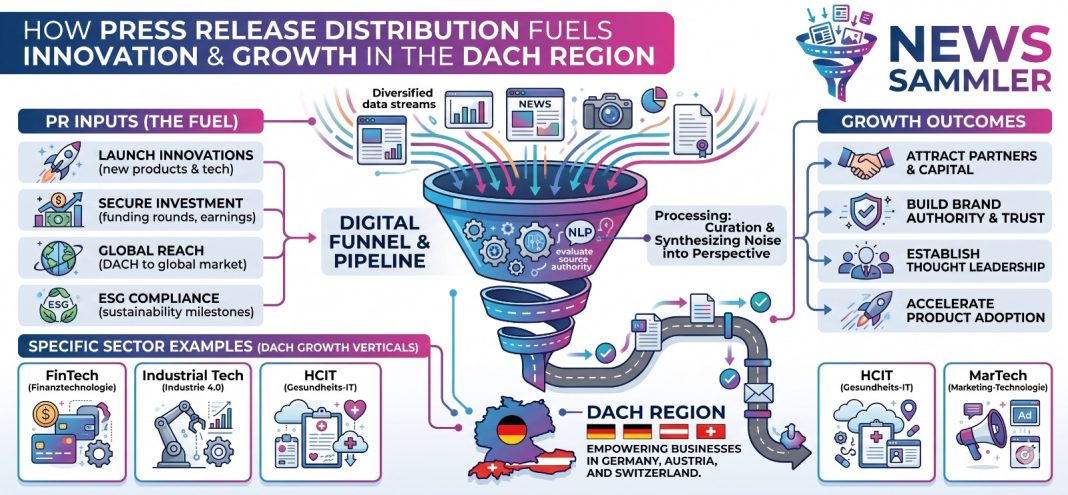
For the economic potential of these announcements to be fully realized, the raw data stream must be captured, categorized, and curated. This is where advanced news aggregation platforms—acting as intelligent digital funnels—become indispensable.
When B2B professionals, investors, and journalists utilize localized, highly categorized DACH news portals, they rely heavily on the influx of direct corporate press releases. The press release is the pure, unfiltered input; the aggregator is the engine that synthesizes this noise into critical perspective. By bringing all these sectors—Economy, FinTech, Industrial Tech, HCIT, and MarTech—into a single, navigable space, the aggregation of press releases allows decision-makers to spot macro trends, identify cross-sector partnerships, and execute strategies faster than ever before.
Conclusion: The Architecture of Future Growth
Press release distribution is far more than a public relations exercise; it is the structural architecture of corporate communication. In the DACH region, where precision, trust, and regulatory adherence are the baseline requirements for doing business, the press release serves as the definitive public record.
By utilizing distribution networks, FinTechs legitimize their disruption, industrial giants secure their supply chains, healthcare innovators navigate complex clinical landscapes, and MarTech firms define the future of digital privacy. As the economies of Germany, Austria, and Switzerland continue to evolve, the transparent, immediate, and widespread distribution of corporate intelligence will remain the ultimate catalyst for sustained regional and global growth. The companies that master this flow of information are the ones that will define the next generation of European industry